
When Liang Congjie, known for founding Friends of Nature, was invited to an ecological festival in Zhangjiajie in western Hunan Province, he was astonished that a dish featuring the Chinese giant salamander was served to him at a welcome dinner. Angered by the disregard for wildlife conservation, Liang decided to leave.
The Chinese giant salamander, an amphibian endemic to China, is commonly known as wawayu in Chinese because its vocalizations bear a striking resemblance to the crying of a human baby. Often regarded as a delicacy, over-hunting, consumption, habitat loss and water pollution have driven the species to the brink of extinction.
Labeled as a “freshwater giant panda”, Chinese giant salamanders have been listed as a protected species since 1988. Over 17 nature reserves designated for the protection of Chinese giant salamanders have been established since 1965.
In the late 20th century, the salamander was also present in Taiwan and was considered a delicacy, resulting in large numbers being caught and smuggled from mainland China.
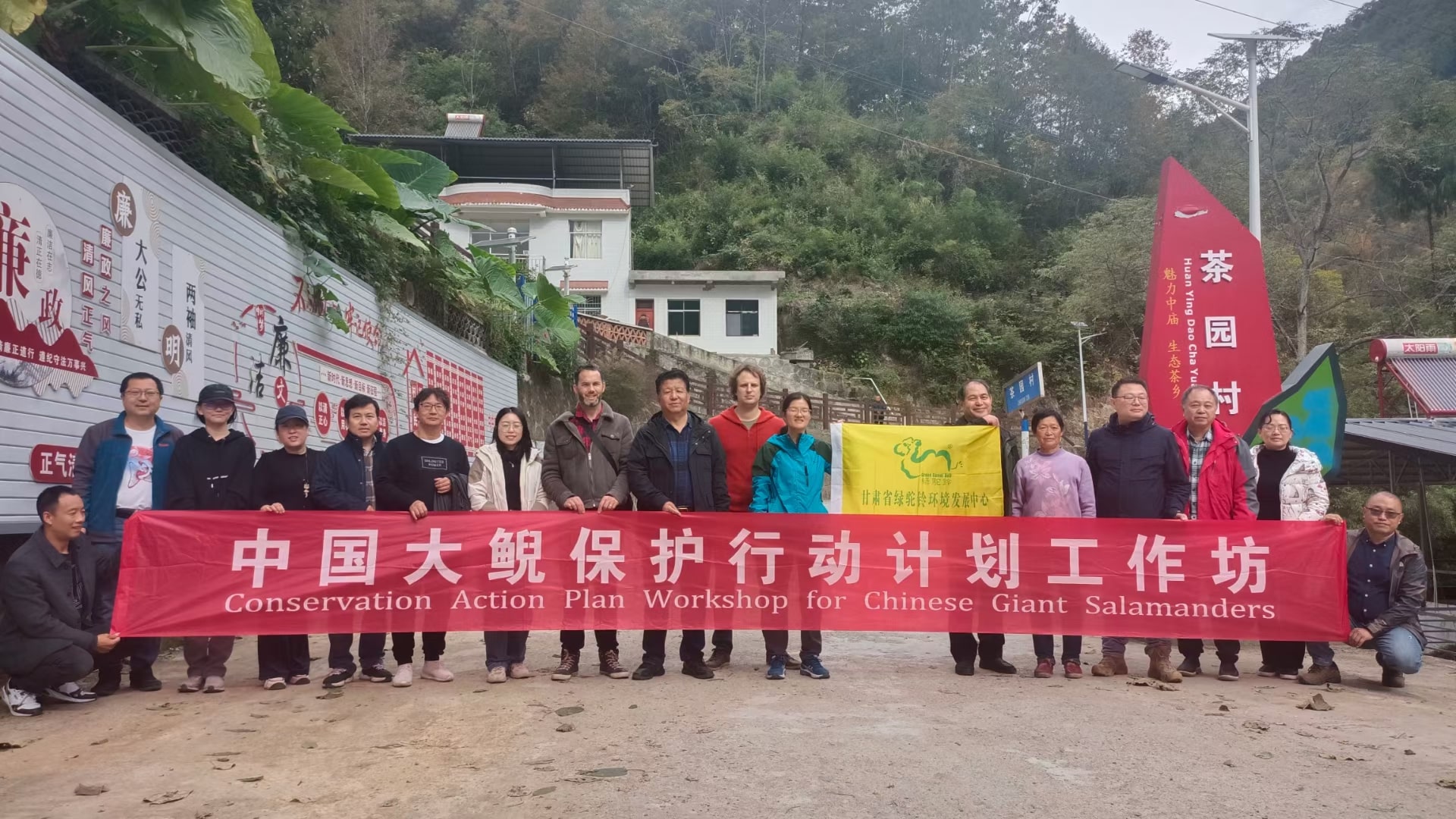
In an effort to save the giant salamanders, Green Camel Bell, an NGO based in Gansu Province, partnered with the Zoological Society of London, holding a Conservation Action Plan Workshop for Chinese giant salamanders in Gansu from Oct 23 to 27. Research institutes, conservation groups and government officials gathered to share research knowledge, conservation experience and lessons learned, and sought a strategy to give the species a sustainable future.
Starting in 2013, the Zoological Society of London organized a nationwide search across China for wild giant salamanders. The team spent four years searching 97 sites in 16 provinces, but only found traces of salamanders at four sites.
In contrast to the dire situation of the wild giant salamander population, the captive breeding farms for giant salamanders have been thriving, which has led to several million giant salamanders being bred in captivity. The purpose of these farms is to supply a sustainable source of salamanders for food. However, stocks have not always been well managed and instances of cross breeding have been common.
When the COVID-19 pandemic began in 2020, the Chinese government banned the trade and consumption of wild animals, including the trade and consumption of giant salamanders. Local governments have since encouraged and compensated farms to release some of their salamanders into the wild.
However, such practices have raised concerns from scientists, with some arguing that cross bred salamanders will negatively impact the genetic integrity of each distinct species; and releasing a non-local species would spell the demise of remaining native inhabitants.
So far, it is still a matter of debate how many species of giant salamander exist in China. It is accepted that there are at least two: the Chinese giant salamander and South China giant salamander. Their international cousins are the Japanese giant salamander, and North American giant salamander which is also known as the hellbender.
During the Trump administration, the hellbender salamander was removed from the federal protection list, despite the fact that the wild population has been in sharp decline. In 2021, five US environmental groups including the Center for Biological Diversity and Waterkeeper Alliance filed a lawsuit demanding the hellbender be re-added to the U.S. Fish and Wildlife Service’s Endangered Species Act protection list. In early September 2023, a federal judge ruled that the removal of the hellbender’s protection status was “arbitrary and unlawful”.
The victory was celebrated by several riverkeeper groups who also joined the lawsuit. “Hellbenders are like the canary in the coal mine,” said Robin Broder, acting executive director of Waterkeepers Chesapeake, “they are incredibly sensitive to pollutants and the destruction of their habitats”.
In Japan, the Japanese giant salamander is doing relatively better since exploitation for food has become less common due to improved conservation awareness. However, the introduction of the Chinese giant salamander, which is bigger in size, into Japanese waterways has caused a crossbreeding problem. In 1972, the same year China and Japan normalized their diplomatic relations, over 800 Chinese giant salamanders were sold to Japan. Subsequent imports over the following years and releases into the wild have turned the Chinese giant salamander into an invasive species in Japan.

Conservationists searching for Chinese giant salamanders in the wild (Photo: Chen Shu)
Inaugurated in 2004, the annual Japan Giant Salamander Conservation Conference convenes researchers, conservation NGOs, government officials and students in Japan to discuss various issues related to the species. The 2023 conference was held in Kozagawa, Wakayama Prefecture, on Oct 28 and 29.
Wang Jie, a scientist from Chengdu Institute of Biology, China Academy of Sciences, travelled to southern Japan in 2014 to conduct research on the Japanese giant salamander. Wang’s work was welcomed and assisted by Japanese researchers in the hope that their support would benefit efforts to protect the Chinese giant salamander. Wang later published numerous articles about his findings in Japan.
International support for research and conservation of the Chinese giant salamander was aided by exhibits of the species in overseas zoos and publicity on its plight for survival. Chinese giant salamanders at both London Zoo in the United Kingdom and Ocean Park in Hong Kong were salamanders that had been rescued from smugglers.
The Darwin Initiative and World Wide Fund for Nature have both funded research projects on the Chinese giant salamander. With funding from the Darwin Initiative, the Zoological Society of London’s EDGE of Existence program has awarded two-year fellowships to several Chinese young conservation leaders including Chen Shu and Yan Fang who have worked tirelessly to ensure the future survival of Chinese giant salamanders.
Yan Fang studied the Chinese giant salamander while pursuing a PhD at Kunming Institute of Zoology. In the summer of 2012, Yan conducted a field survey in Qinghai, with an attempt to locate relict Chinese giant salamanders on the Tibetan Plateau (its existence in the area was previously recorded in 1966). Ning Zuomei and Mao Jing of the Snow Alliance, a Qinghai-based environmental NGO, travelled to Kunming in 2019 and recorded Yan giving a special lecture on the Chinese giant salamander to be used for an online course on biodiversity conservation funded by the Zoological Society of London.
Zhao Zhong, a board member of the Snow Alliance and founder of Green Camel Bell, has been working on nature conservation in southern Gansu for over a decade. His interest in the conservation of the Chinese giant salamander in the wild and in efforts to find alternative solutions for existing giant salamander farms in southern Gansu led him to organize the late October conference. Zhao Zhong believes that protecting the livelihoods of local communities will help win more support for conservation work from locals.
Zhilan Foundation, an environmental grant maker with a focus on endangered species, has provided two major grants for the research and conservation of the Chinese giant salamander in Zhangjiajie. In February 2020, the Zhangjiajie government outlawed the trade and consumption of Chinese giant salamanders. Though serving Chinese giant salamander as a delicacy is a die-hard custom in western Hunan Province, conservation efforts and growing public awareness will hopefully help turn the tide and stop them becoming extinct.
I’m really impressed together with your writing abilities and also with the structure in your weblog. Is that this a paid theme or did you customize it yourself? Anyway stay up the excellent quality writing, it’s rare to look a nice weblog like this one nowadays!
Thanks designed for sharing such a pleasant thought, piece of writing is pleasant,
thats why i have read it fully
Hello to all, how is the whole thing, I think
every one is getting more from this web page, and your views are good
in support of new viewers.
Hi there! This post couldn’t be written much better!
Looking at this post reminds me of my previous roommate!
He continually kept talking about this. I’ll forward this post to him.
Pretty sure he will have a very good read. Thank you for
sharing!
Hi, i think that i saw you visited my site so i came to “return the favor”.I’m attempting to find things to improve
my web site!I suppose its ok to use some of your ideas!!
Wow, awesome blog layout! How long have you been blogging for?
you make blogging look easy. The overall look of your web site is fantastic,
as well as the content!
I’m now not positive the place you’re getting your info, but great topic.
I must spend some time studying more or figuring out more.
Thank you for wonderful info I was in search of this information for my mission.
Hey! I just wanted to ask if you ever have any issues with hackers?
My last blog (wordpress) was hacked and I ended up losing several
weeks of hard work due to no back up. Do you have any methods to protect against hackers?
I was curious if you ever thought of changing the layout of your website?
Its very well written; I love what youve got to say.
But maybe you could a little more in the way of content so people could connect with
it better. Youve got an awful lot of text for only having
one or two pictures. Maybe you could space it
out better?
I’m truly enjoying the design and layout of your website.
It’s a very easy on the eyes which makes it much more pleasant for me to come
here and visit more often. Did you hire out a developer to create your theme?
Outstanding work!
Hi there, always i used to check webpage posts here early in the morning, because i love to
learn more and more.
Normally I do not read article on blogs, but I wish to say that this
write-up very forced me to take a look at and do it! Your writing taste
has been amazed me. Thanks, quite great post.
Its not my first time to pay a visit this site,
i am browsing this web site dailly and take pleasant facts from here everyday.
Attractive part of content. I just stumbled upon your web site and in accession capital to claim that I get in fact loved account your blog posts.
Anyway I will be subscribing for your augment or even I success you get admission to consistently fast.
I’m gone to tell my little brother, that he should also pay a visit this
website on regular basis to get updated from latest news
update.
I was suggested this website by my cousin. I’m
not sure whether this post is written by him as nobody else know such detailed
about my trouble. You’re incredible! Thanks!
You actually make it seem so easy with your presentation but I find this matter to be
actually something that I think I would never understand.
It seems too complicated and extremely broad for me. I
am looking forward for your next post, I will try to get
the hang of it!
Keep on working, great job!
My brother recommended I might like this web site. He was entirely
right. This post truly made my day. You cann’t imagine
just how much time I had spent for this info! Thanks!
Hello I am so delighted I found your webpage, I really found you by
mistake, while I was looking on Digg for something else, Anyhow I am here now and would just like to say
thank you for a remarkable post and a all round
exciting blog (I also love the theme/design), I don’t have time to read through it all at the minute but I have book-marked it and also added in your RSS feeds, so when I have time I will be back to read much more, Please do keep up
the excellent work.
If some one wants to be updated with latest technologies
after that he must be pay a quick visit this site and be up to date everyday.
Hello very nice website!! Guy .. Excellent .. Superb ..
I’ll bookmark your site and take the feeds additionally?
I am happy to seek out numerous useful information right here within the post,
we need develop extra techniques on this regard, thanks for sharing.
. . . . .
Having read this I believed it was very enlightening. I appreciate you
spending some time and energy to put this short article together.
I once again find myself spending a lot of time both reading and posting comments.
But so what, it was still worthwhile!
It’s a shame you don’t have a donate button! I’d definitely donate to this superb blog!
I suppose for now i’ll settle for bookmarking and adding your RSS feed to my Google account.
I look forward to brand new updates and will talk about this site with my Facebook group.
Chat soon!
My developer is trying to convince me to move to .net from PHP.
I have always disliked the idea because of the costs. But he’s tryiong none the less.
I’ve been using WordPress on several websites for about a year and am nervous about switching to
another platform. I have heard great things about blogengine.net.
Is there a way I can import all my wordpress content into it?
Any help would be really appreciated!
What a material of un-ambiguity and preserveness of valuable knowledge on the topic of unpredicted feelings.
Attractive section of content. I just stumbled upon your website
and in accession capital to assert that I get in fact enjoyed account your blog posts.
Any way I’ll be subscribing to your feeds and even I achievement you access
consistently rapidly.
Have you ever considered creating an ebook or guest authoring on other
sites? I have a blog centered on the same ideas you discuss and would really like to have you share some stories/information. I know my readers would appreciate your work.
If you are even remotely interested, feel free to send me an e mail.
What i don’t realize is in fact how you are no longer really much more well-appreciated than you might be right now.
You are so intelligent. You recognize therefore significantly relating to this topic, made me in my view believe it from numerous various angles.
Its like men and women don’t seem to be interested unless it is something to do with Lady gaga!
Your personal stuffs outstanding. At all times take care of it up!
I like the helpful info you provide in your articles. I will bookmark your blog and check again here frequently.
I’m quite certain I will learn many new stuff
right here! Good luck for the next!
Hey very interesting blog!
What’s up to every one, the contents present at this website are truly amazing for people knowledge, well, keep up the nice work fellows.